
NSOU Short Term Courses (STCs): Eligibility, Fees, Duration and Syllabus 2026
Part of NSOU Programmes: NSOU PG Courses 2026: List, Fees, Eligibility and Admission
NSOU offers several Short Term Courses (STCs) for the January and July 2026 sessions through its School of Professional Studies and Centre for Lifelong Learning. Students can find details on eligibility, fees, duration, and syllabus in the recently published prospectus. Admissions for the Certificate in Communicative English for January 2026 closed on January 21, 2026.
- NSOU offers Short Term Courses through its Innovation and Incubation Centre and Centre for Lifelong Learning.
- Courses are available for January and July 2026 sessions.
- Programmes include Diplomas in Taxation, Banking & Finance, and Certificates in AI and Communicative English.
- Delivery modes for STCs include blended, online, and face-to-face.
- Eligibility for NSOU STCs generally requires 10+2 or a graduate degree.
In this article
- NSOU Short Term Courses: Important Dates 2026
- NSOU Short Term Courses: Programmes Offered and Duration
- NSOU Short Term Courses: Eligibility Criteria
- NSOU Short Term Courses (STCs): Fee Structure
- NSOU Short Term Courses: Syllabus Overview
- How to Apply for NSOU Short Term Courses
- NSOU Short Term Courses: Mode of Delivery
- NSOU Short Term Courses (STCs) official links and PDFs
- What students ask about NSOU Short Term Courses (STCs)
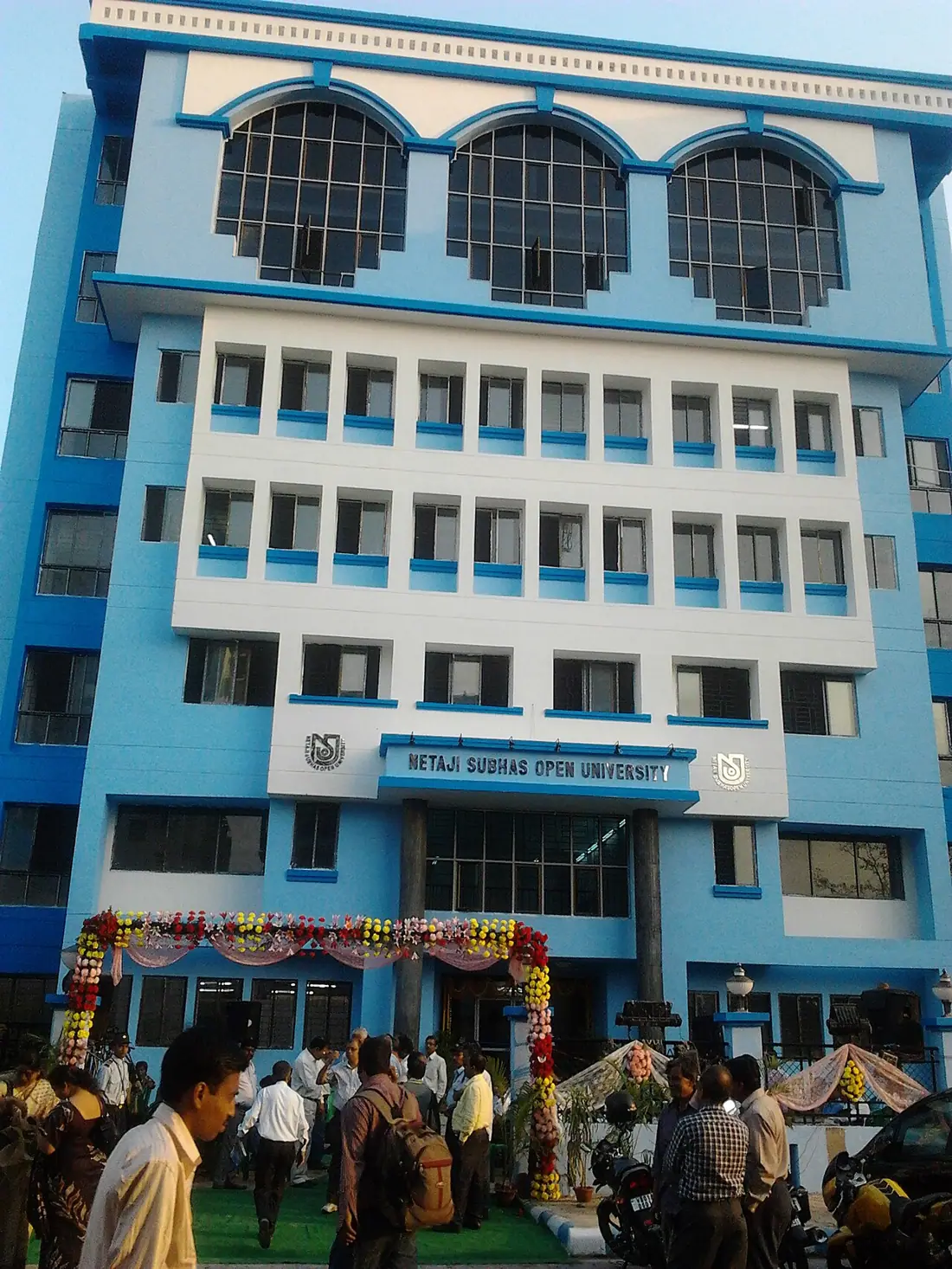
Netaji Subhas Open University (NSOU), the only State Open University in West Bengal, offers various Short Term Courses (STCs) through its Innovation and Incubation Centre (IIC) under the School of Professional Studies and the Centre for Lifelong Learning. These courses are designed to provide specialized skills and professional growth opportunities for students and working professionals. NSOU offers these programmes in blended, online, and face-to-face modes, with admissions for the January and July sessions in 2026.
NSOU Short Term Courses: Important Dates 2026
Netaji Subhas Open University has announced various key dates for its Short Term Courses for the 2026 academic year. These dates include admission opening and closing deadlines for specific programmes offered through the School of Professional Studies and the Centre for Lifelong Learning. Students should note these deadlines for timely application to their desired courses.
NSOU Short Term Course Important Dates 2026
| Event | Programme | Session | Date |
|---|---|---|---|
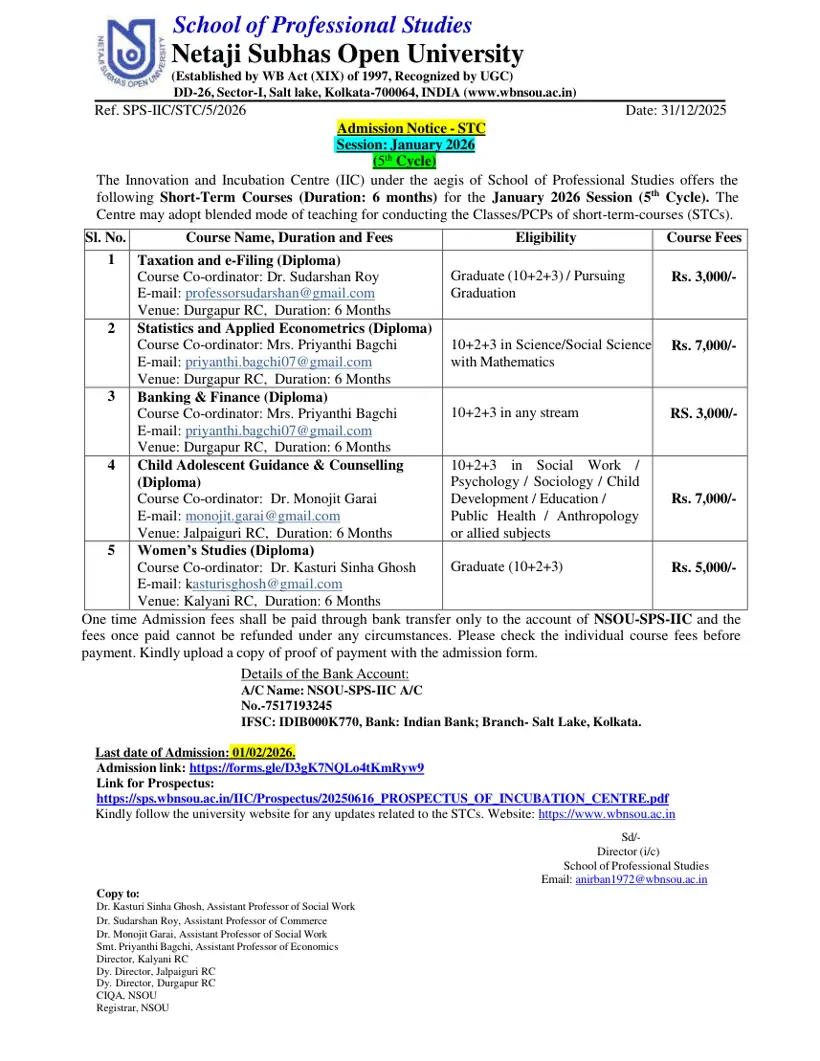
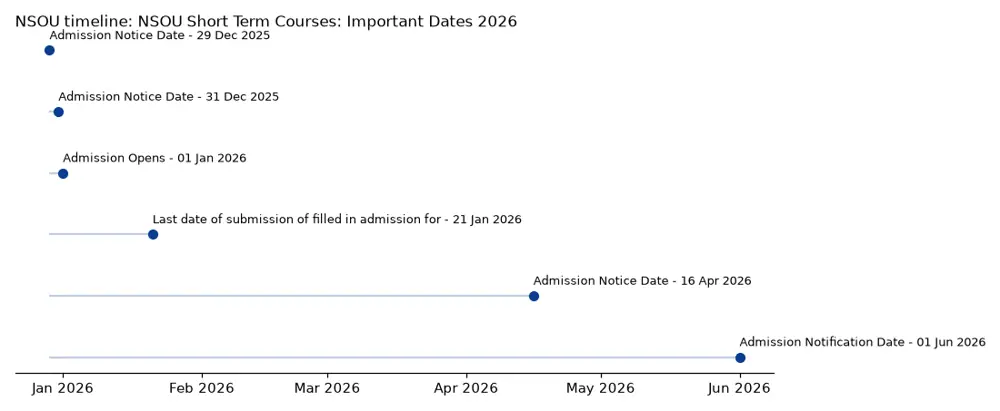
| Admission Notice Date | Diploma in Taxation and e-Filing, Statistics and Applied Econometrics, Banking & Finance, Child Adolescent Guidance & Counselling | January 2026 (5th Cycle) | 31/12/2025 |
| Admission Notice Date | Certificate in Communicative English (CICE) | January 2026 to March 2026 | 29/12/2025 |
| Admission Opens | Certificate in Communicative English (CICE) | January 2026 to March 2026 | 01.01.2026 |
| Last date of submission of filled in admission form & Fees | Certificate in Communicative English (CICE) | January 2026 to March 2026 | 21.01.2026 |
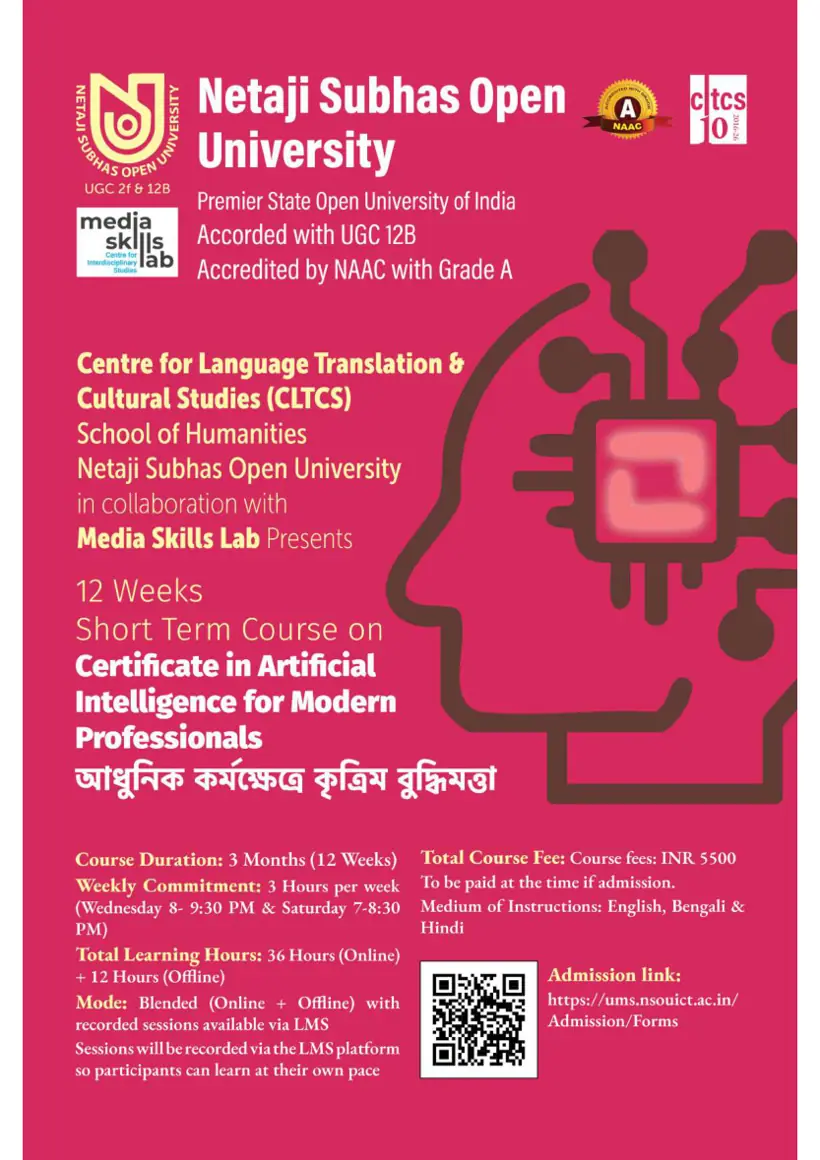
| Admission Notice Date | Certificate in Artificial Intelligence for Modern Professionals | 2026 | 16/04/2026 |
| Admission Notification Date | Fire and Safety Skill, Beauty Therapy and Hair Dressing, Diploma in Land Survey, Advanced Diploma in Disaster Risk Management, Diploma in Yoga Education, Diploma in Stress Management with Meditation, Diploma in Naturopathy | July 2026 | 01/06/2026 |
The essentials
| University | Netaji Subhas Open University (NSOU) |
|---|---|
| Programmes | Short Term Courses (STCs) |
| Academic Sessions | January 2026, July 2026 |
| Mode of Study | Blended (Online + Offline), Online, Face-to-face |
| Offering Centres | Innovation and Incubation Centre (IIC), Centre for Lifelong Learning (CLL) |
NSOU Short Term Courses: Programmes Offered and Duration
Netaji Subhas Open University offers a range of Short Term Courses through its various schools and centres, catering to diverse professional development needs. These programmes vary in duration, typically ranging from three months to one year, and are designed to impart specialized skills. The courses are offered in both January and July sessions.
NSOU Short Term Courses and Durations
| Programme Name | Offering Centre | Duration | Session |
|---|---|---|---|
| Diploma in Taxation and e-Filing | IIC, School of Professional Studies | 6 Months | January / July |
| Diploma in Statistics and Applied Econometrics | IIC, School of Professional Studies | 6 Months | January / July |
| Diploma in Banking & Finance | IIC, School of Professional Studies | 6 Months | January / July |
| Diploma in Child Adolescent Guidance & Counselling | IIC, School of Professional Studies | 6 Months | January / July |
| Diploma in Library Automation and Networking | IIC, School of Professional Studies | 6 Months | January / July |
| Diploma in Women’s Empowerment and Development | IIC, School of Professional Studies | 6 Months | January / July |
| Certificate in Artificial Intelligence for Modern Professionals | Centre for Interdisciplinary Studies, CLTCS, School of Humanities | 3 Months (12 Weeks) | 2026 |
| Certificate in Communicative English (CICE) | Centre for Language, Translation and Cultural Studies (CLTCS), School of Humanities | 3 Months (January 2026 to March 2026) | January 2026 |
| Fire and Safety Skill | Centre for Lifelong Learning, School of Vocational Studies | 6-months | July 2026 |
| Beauty Therapy and Hair Dressing (Certificate/ Diploma) | Centre for Lifelong Learning, School of Vocational Studies | Not specified | July 2026 |
| Diploma in Land Survey | Centre for Lifelong Learning, School of Vocational Studies | 1-year | July 2026 |
| Advanced Diploma in Disaster Risk Management | Centre for Lifelong Learning, School of Vocational Studies | 1-year | July 2026 |
| Diploma in Yoga Education | Centre for Lifelong Learning, School of Vocational Studies | 1-year | July 2026 |
| Diploma in Stress Management with Meditation | Centre for Lifelong Learning, School of Vocational Studies | 12-month | July 2026 |
| Diploma in Naturopathy | Centre for Lifelong Learning, School of Vocational Studies | 12-month | July 2026 |
NSOU Short Term Courses: Eligibility Criteria
Eligibility requirements for NSOU Short Term Courses vary depending on the specific programme, ensuring that candidates possess the foundational knowledge necessary for successful completion. Generally, qualifications range from Class X to a graduate degree in a relevant field. Students must meet the specified criteria for their chosen course to be considered for admission.
NSOU Short Term Course Eligibility Requirements
| Programme Name | Minimum Qualification |
|---|---|
| Diploma in Taxation and e-Filing | Graduate (10+2+3) / Pursuing Graduation |
| Diploma in Statistics and Applied Econometrics | 10+2+3 in Science/Social Science with Mathematics |
| Diploma in Banking & Finance | 10+2+3 in any stream |
| Diploma in Child Adolescent Guidance & Counselling | 10+2+3 in Social Work / Psychology / Sociology / Child Development / Anthropology and other allied multidisciplinary subjects |
| Diploma in Library Automation and Networking | 10+2+3 in any stream |
| Diploma in Women’s Empowerment and Development | 10+2+3 in any stream |
| Certificate in Artificial Intelligence for Modern Professionals | Not specified in sources |
| Certificate in Communicative English (CICE) | 10 + 2 or its equivalent |
| Fire and Safety Skill | Class X |
| Beauty Therapy and Hair Dressing (Certificate/ Diploma) | Class-VIII/10+2 |
| Diploma in Land Survey | 10+2 |
| Advanced Diploma in Disaster Risk Management | 10+2+3 |
| Diploma in Yoga Education | 10+2 |
| Diploma in Stress Management with Meditation | 10+2 |
| Diploma in Naturopathy | 10+2 |
NSOU: related tasks
NSOU Short Term Courses (STCs): Fee Structure
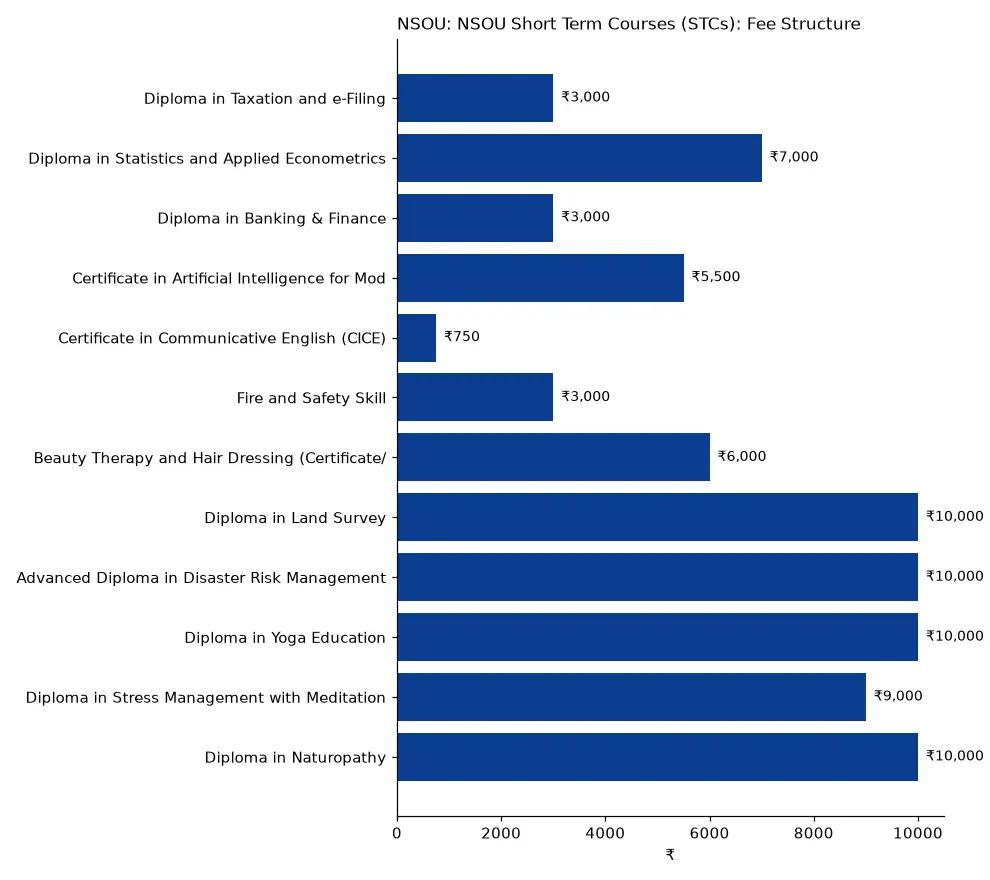
Netaji Subhas Open University has published the fee structure for its Short Term Courses for the 2026 sessions. Fees vary by programme and are payable at the time of admission. Students should refer to the specific admission notices or prospectuses for the exact amount for their chosen course.
NSOU Short Term Course Fees 2026
| Programme Name | Course Fees (INR) | Session |
|---|---|---|
| Diploma in Taxation and e-Filing | 3,000/- | January 2026 |
| Diploma in Statistics and Applied Econometrics | 7,000/- | January 2026 |
| Diploma in Banking & Finance | 3,000/- | January 2026 |
| Diploma in Child Adolescent Guidance & Counselling | Not specified in sources for January 2026 | January 2026 |
| Diploma in Library Automation and Networking | Not specified in sources | Not specified |
| Diploma in Women’s Empowerment and Development | Not specified in sources | Not specified |
| Certificate in Artificial Intelligence for Modern Professionals | 5,500/- | 2026 |
| Certificate in Communicative English (CICE) | 750/- | January 2026 |
| Fire and Safety Skill | 3,000/- | July 2026 |
| Beauty Therapy and Hair Dressing (Certificate/ Diploma) | 6,000/- | July 2026 |
| Diploma in Land Survey | 10,000/- | July 2026 |
| Advanced Diploma in Disaster Risk Management | 10,000/- | July 2026 |
| Diploma in Yoga Education | 10,000/- | July 2026 |
| Diploma in Stress Management with Meditation | 9,000/- | July 2026 |
| Diploma in Naturopathy | 10,000/- | July 2026 |
NSOU Short Term Courses: Syllabus Overview
Netaji Subhas Open University designs its Short Term Courses with specific objectives to equip learners with practical and theoretical knowledge relevant to the job market. The syllabi are structured into modules covering key concepts and applications in each discipline. Some programmes also incorporate blended learning modes, combining online and offline components.
The Diploma in Taxation and e-Filing programme focuses on delivering concepts of Goods and Services Tax (GST), Customs Duty, Income Tax, and e-Filing. It aims to provide practical knowledge of tax planning and filing, enabling learners to identify basic concepts, terms, and legal formalities related to taxation. The course also covers calculation of total income, taxability, residential status, and incidence of tax.
The Diploma in Statistics and Applied Econometrics programme aims to develop in-depth knowledge about statistics and econometrics, which are essential tools for understanding economic problems and conducting research. It includes applications in specialized software packages like E-Views and STATA. The course aims to provide basic methods for empirical research and enhance the ability to perform quality empirical work.
The Diploma in Banking & Finance course provides a basic understanding of the connections between money, the financial system, and the broader macroeconomy. It examines the economics of modern financial institutions, including their organization, products, services, risks, and regulation. The programme covers topics such as Financial Market and Insurance, Modern Banking, Behavioral Finance, Stocks, Bonds, Dividends, Shares, Risk and Return, Recessions, Bubbles, and Mortgage Crisis.
The Diploma in Child Adolescent Guidance & Counselling programme aims to create professionals and provide personal growth opportunities for those working with children and adolescents. Key objectives include recognizing differences among students, identifying personal, familial, and educational problems, administering and interpreting basic tests, and helping students with learning difficulties. It also covers evaluating developmental issues and assisting students in choosing professional counseling courses.
The Diploma in Library Automation and Networking programme aims to build skills for students, researchers, and library professionals in emerging areas like Information & Communication Technology (ICT) within Library & Information Science (LIS). The course structure includes modules on Resource Identification, Services and Utilization, Knowledge Organisation, Resource Description, and Use of ICT. It seeks to enhance professional efficiency and efficacy in the LIS domain.
The Diploma in Women’s Empowerment and Development programme aims to train participants to understand the status of women in society and equip them to address women’s problems. It focuses on working towards women’s empowerment and, in the long run, contributing to the sustainable development of society. The course is delivered in a blended mode, combining online and offline components.
The Certificate in Artificial Intelligence for Modern Professionals is a 12-week course focusing on Artificial Intelligence in the Modern Workplace. It is delivered in a blended mode, combining online and offline sessions, with recorded sessions available via the Learning Management System (LMS). The total learning hours are 36 hours online and 12 hours offline.
How to Apply for NSOU Short Term Courses
The application process for Netaji Subhas Open University’s Short Term Courses is primarily conducted online, requiring candidates to access specific admission portals or the university website. Students must complete the admission form and pay the requisite fees by the stated deadlines for their chosen programme. It is essential to refer to the individual course notices for precise instructions.
- Access the e-Brochure and admission form from the NSOU website.
- Complete the online admission process.
- Submit the filled admission form and pay the course fees of INR 750/- by January 21, 2026.
NSOU Short Term Courses: Mode of Delivery
Netaji Subhas Open University employs various modes of delivery for its Short Term Courses to ensure accessibility and flexibility for learners. Programmes are offered in offline, face-to-face, online, and blended modes, integrating ICT components with traditional teaching methods. This approach facilitates anytime, anywhere learning and promotes inclusive education.
NSOU Short Term Course Delivery Modes
| Programme Name | Mode of Delivery |
|---|---|
| Diploma in Taxation and e-Filing | Offline and face to face mode |
| Diploma in Statistics and Applied Econometrics | Offline and face to face mode |
| Diploma in Banking & Finance | Blended Mode (Online and Offline) |
| Diploma in Child Adolescent Guidance & Counselling | Offline and face to face mode |
| Diploma in Library Automation and Networking | Blended Mode (Online and Offline) |
| Diploma in Women’s Empowerment and Development | Blended Mode (Online and Offline) |
| Certificate in Artificial Intelligence for Modern Professionals | Blended (Online + Offline) with recorded sessions via LMS |
| Certificate in Communicative English (CICE) | Online mode through NSOU LMS |
| Fire and Safety Skill | Not specified in sources |
| Beauty Therapy and Hair Dressing (Certificate/ Diploma) | Not specified in sources |
| Diploma in Land Survey | Not specified in sources |
| Advanced Diploma in Disaster Risk Management | Not specified in sources |
| Diploma in Yoga Education | Not specified in sources |
| Diploma in Stress Management with Meditation | Not specified in sources |
| Diploma in Naturopathy | Not specified in sources |
NSOU Short Term Courses (STCs) official links and PDFs
- Visit the NSOU official websitewbnsou.ac.in ↗
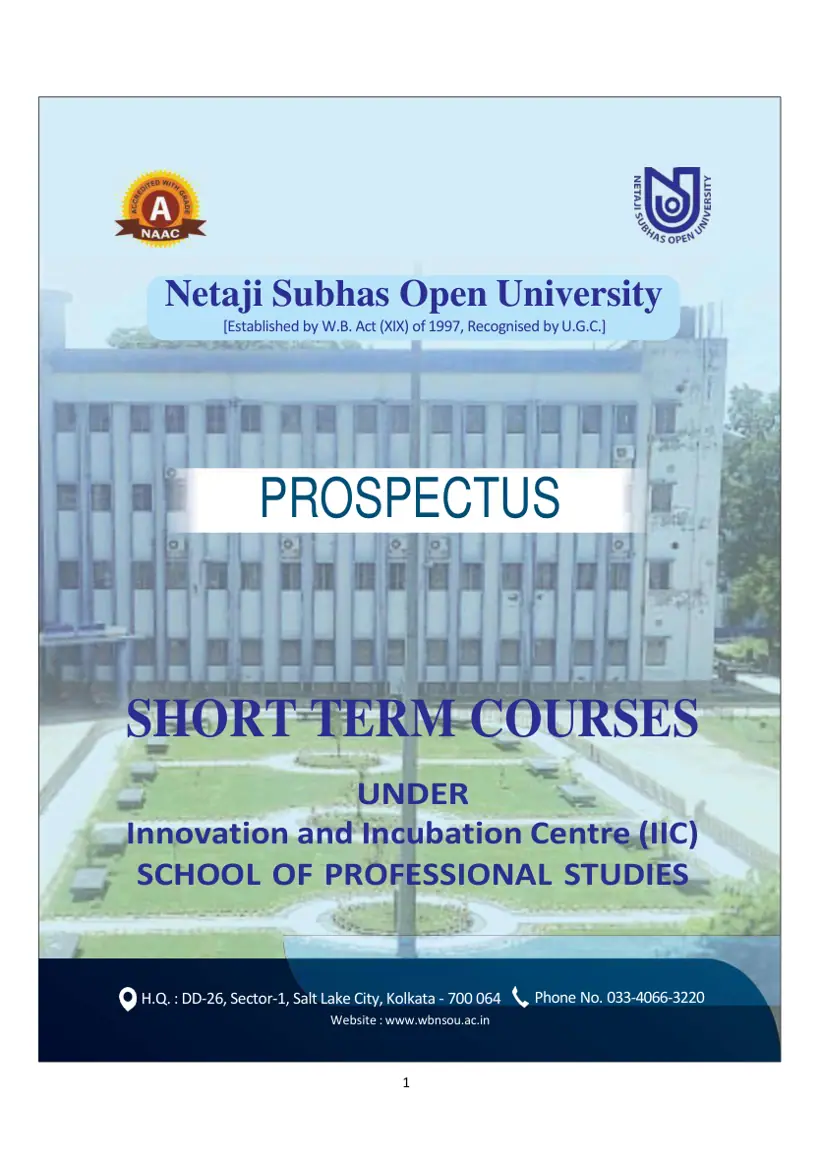
- NSOU SPS Innovation Incubation Centre Short Term Courses Prospectus PDF — NSOU SPS Innovation Incubation Centre Short Term Courses Prospectus
What students ask about NSOU Short Term Courses (STCs)
What is the eligibility and fee for the NSOU Diploma in Taxation and e-Filing course?
Candidates must be graduates (10+2+3) or currently pursuing graduation to apply for the Diploma in Taxation and e-Filing at NSOU. The course fee for the January 2026 session is Rs. 3,000. Training runs for six months under the Innovation and Incubation Centre at Durgapur Regional Campus.
How can students apply for the NSOU Certificate in Artificial Intelligence for Modern Professionals?
Applicants must register online via the NSOU official website or www.cltcsnsou.in. Registration and fee payment of INR 5,500 for the May to July 2026 batch were open from 17th April 2026 until 20th May 2026 midnight. Graduates or those pursuing graduation are eligible for this 12-week blended course.
What are the admission requirements and fee for the NSOU Certificate in Communicative English?
Candidates who passed 10+2 or its equivalent examination are eligible for the Certificate in Communicative English (CICE) at NSOU. The total course fee is Rs. 750 payable during online admission. Applications for the January to March 2026 session were accepted online from 01.01.2026 to 21.01.2026 with 50 students per batch.
What short-term diploma courses does NSOU offer under the Centre for Lifelong Learning in July 2026?
NSOU offers one-year diploma courses including Land Survey, Yoga Education, and Naturopathy under the Centre for Lifelong Learning for July 2026. Eligibility for these programmes requires passing 10+2. The fee is Rs. 10,000 for Land Survey, Yoga Education, and Naturopathy, while Diploma in Stress Management with Meditation costs Rs. 9,000.
What is the eligibility and course fee for the Diploma in Banking & Finance at NSOU?
Applicants must hold a 10+2+3 degree in any stream to qualify for the Diploma in Banking & Finance at NSOU. The programme fee for the January 2026 session is Rs. 3,000 for a duration of six months. Delivery is managed in blended mode across 24 credits and 600 total marks.
Who can apply for the NSOU Diploma in Statistics and Applied Econometrics?
Candidates holding a 10+2+3 degree in Science or Social Science with Mathematics are eligible for the Diploma in Statistics and Applied Econometrics at NSOU. The course fee for the January 2026 session is Rs. 7,000 for six months of training. Classes take place at Durgapur Regional Campus under the Innovation and Incubation Centre.
What is the qualification required for the NSOU Diploma in Child Adolescent Guidance & Counselling?
Applicants require a 10+2+3 degree in Social Work, Psychology, Sociology, Child Development, Anthropology, or allied multidisciplinary subjects. The six-month course is conducted under the Innovation and Incubation Centre for January and July sessions. Academic activities and coordination are handled at Jalpaiguri Regional Campus.
More on Courses & Fees
- NSOU B.Ed 2026: Eligibility, Fee, Duration and Syllabus
- NSOU MA Admission 2026: Eligibility, Fees, Duration and Syllabus
- NSOU B.Sc Courses 2026-2027: FYUG Eligibility, Syllabus and Exit Rules
- NSOU MSc Admission July 2026: Fee, Courses and Counselling
- NSOU BA Admission Last Date, Eligibility, and Fee Structure 2026-2027
- NSOU Diploma Course List, Exam Schedules and Syllabus Details 2026